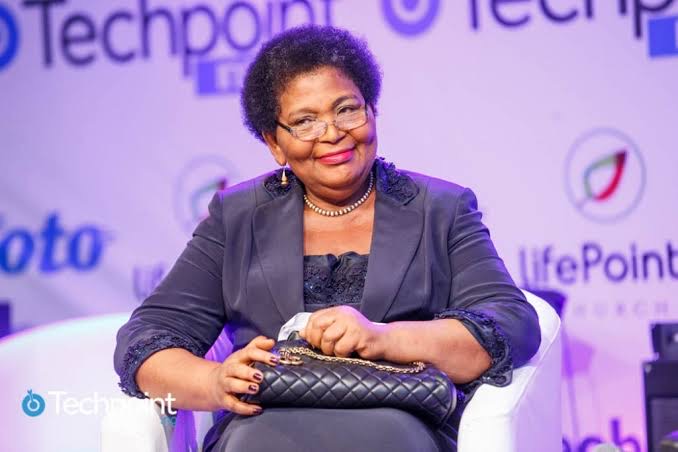
Last Saturday, March 22, 2025, marked the 79th birthday of Dr. (Mrs.) Cecilia Ibru, Nigeria’s first female bank MD/CEO. In celebration, she launched two books: Cecilia: The Autobiography of Cecilia Ibru and a memoir. The autobiography, which provides a deep dive into her journey, reveals the fascinating and unexpected origins of Oceanic Bank—a financial institution born from a direct presidential offer.
A Presidential Offer That Changed Everything
As narrated in her book, Oceanic Bank’s foundation was laid in an unexpected moment in 1987 when then-President Ibrahim Babangida made an offer to Cecilia’s husband, Olorogun Michael Ibru. On page 208, she recounts the pivotal moment:
“One day, during one of our visits to the Aikhomu family, we had the rare opportunity to meet President Babangida, who had come to visit the Admiral (Augustus Aikhomu, Vice President). As was customary, the men gathered in the study, while the women sat in the dining room or parlour with Mrs. Aikhomu.
“At one point, as the President was about to leave, he suddenly turned back, peeked into the study, and asked my husband, ‘Chief, which is your bank?’
“Surprised by the question, my husband replied, ‘None, Sir!’
“The President seemed taken aback. He told my husband, ‘Your many businesses are enough to run a bank. I have three banking licenses left, and I will reserve one for you. Hurry up with your application and come for your licence urgently.’
“That conversation marked the beginning of a new chapter for us. My husband quickly applied, and as promised, we obtained the banking licence.”
The Business Empire Behind the Bank
Before that moment, Olorogun Michael Ibru had already established himself as one of Nigeria’s most formidable businessmen. On page 197, Cecilia details how her husband built an empire spanning multiple industries:
“My husband had an unrelenting drive to participate actively in Nigeria’s commercial landscape. He saw opportunities in every sector and seized them with a determination that set him apart as a major player in the economy. One of the defining moments of his business career was his significant involvement in the indigenisation of corporate entities in Nigeria. This policy mandated that foreign-owned companies relinquish 40% of their stake to Nigerians, opening up massive investment opportunities.
“With his financial strength, my husband acquired substantial shares in various companies, including Elf Oil Company, Zabadne, Boskalis, Aero, Mitchel Farms, Dow Chemicals, Nigerian Hardwood, Flower Shop, W.F Clark, Nitrec, and many others. This diversification of interests expanded the Ibru Organisation tremendously, enabling him to provide opportunities for many members of his family. Each member, including the women, was given a business to head and manage, ensuring that wealth and enterprise ran through the family.
“At some point, it seemed as though I was the only member of the family who was not running a corporate venture.”
The Challenge of Raising Capital
Despite securing a banking licence, Oceanic Bank’s launch was not without obstacles. The most immediate challenge was raising the required N20 million capital to deposit with the Central Bank of Nigeria (CBN). Cecilia recounts the struggle on pages 208-210:
“With the licence secured, the next challenge was raising the required N20 million to deposit with the Central Bank of Nigeria (CBN) as a prerequisite for obtaining the final permit to commence operations.
“My husband, confident in his business connections, believed that securing the funds would be easy. However, to our shock, many of those who had previously promised financial support suddenly became unreachable.
“The timeframe for payment was strict, and the risk of losing the licence due to non-payment loomed over us. Meanwhile, we had turned a large section of our house into a workstation where we strategised and planned the launch of the bank into the Nigerian corporate space.
“As we struggled to secure funding, we had a cargo shipment on the high seas, which had been purchased by an American Petroleum Company. We had prayed that the profit from this cargo would help fund the bank.
“But then came devastating news—the cargo had been declared distressed and could no longer be sold! It was a major setback!
“Determined to find a solution, I suggested that my husband reach out to his contacts in Spain. With renewed hope, he made the call, and to our great relief, his Spanish contact agreed to take the product and paid for it immediately.”
The Divine Revelation Behind Oceanic Bank’s Logo
A moment of divine inspiration would later shape the identity of Oceanic Bank. While in London, Cecilia purchased a leather-bound copy of the New King James Bible for her husband. She describes what followed:
“When I returned home and presented the Bible to him, he was so pleased that he began reading it immediately.
“The next morning, he excitedly told me that he had found the logo for the bank in the first chapter of the Bible.
“Curious, I sat down with him as he sketched the design, explaining the inspiration behind it.
“From that day on, every time I saw the logo of Oceanic Bank, I would be reminded of the story of creation—a divine revelation that became the foundation of our vision for the bank.”
Betrayal and the Birth of Nigeria’s First Female Bank CEO
Oceanic Bank faced its first major crisis when top management staff were caught in a massive fraud, leading to a $2 million loss. The scandal led to the dismissal of several executives, including the then-managing director. Cecilia, who had been serving as General Manager of Administration and Personnel, suddenly found herself the only senior executive left to lead the bank. On pages 211-214, she recalls:
“With three years of experience in banking, I stepped up as the Managing Director, determined to steer Oceanic Bank through the crisis.
“Despite the betrayal and financial loss, Oceanic Bank survived. What many thought would be the end of our institution turned into a new beginning. By navigating strategic partnerships, adapting to economic reforms, and building public trust, we regained our stability.
“Stepping into the leadership role was not easy, but it taught me the importance of resilience, adaptability, and vision. Oceanic Bank emerged stronger, proving that even in the face of adversity, with the right leadership and determination, success was still possible.”
Obasanjo’s Economic Reforms and Their Impact on the Ibrus
Cecilia also sheds light on how former President Olusegun Obasanjo’s aggressive economic policies affected major business moguls, including her family. On pages 241-244, she describes an era of bold reforms and power struggles:
“One of the most remarkable achievements of Obasanjo’s presidency was Nigeria’s successful negotiation for debt forgiveness. This feat was largely driven by Dr. Ngozi Okonjo-Iweala, who worked tirelessly with international financial institutions to secure significant relief from Nigeria’s crippling foreign debt.
“During his second term, Obasanjo became increasingly assertive, taking a hard stance on individuals and corporations that he believed had gained too much economic influence. He targeted several high-profile business moguls, including Mike Adenuga, over issues related to oil bloc allocations.”
The political and economic battles of the era highlighted the struggles of business leaders in navigating government policies and shifting power dynamics.
A Legacy of Resilience and Vision
Dr. (Mrs.) Cecilia Ibru’s rise to become Nigeria’s first female bank CEO was not by design but by necessity. Her story, as told in her autobiography, is one of resilience, determination, and divine guidance. Oceanic Bank, born from a presidential offer and built through perseverance, became a pillar in Nigeria’s financial sector—cementing Cecilia Ibru’s place in history.